Dropped from the Indian squad after scoring the fastest double century in ODI history against Bangladesh, Ishan Kishan found himself frozen out for two years, left without a central contract, his last T20I a distant memory from a November night in Guwahati against Australia.
Yet here he is, India’s most destructive opener at the T20 World Cup 2026, smashing a record 77 against Pakistan on a pitch that broke everyone else.
This is the story of Ishan Kishan’s two-year exile, his grinding comeback through domestic cricket, a maiden Syed Mushtaq Ali title for Jharkhand, and how a player who re-entered the squad as a reserve quietly made himself impossible to leave out.
Ishan Kishan in Early Days
Born on July 18, 1998, in Patna, Ishan Kishan made his first-class debut for Jharkhand at just 16, scoring a century and five fifties in his first ten matches.
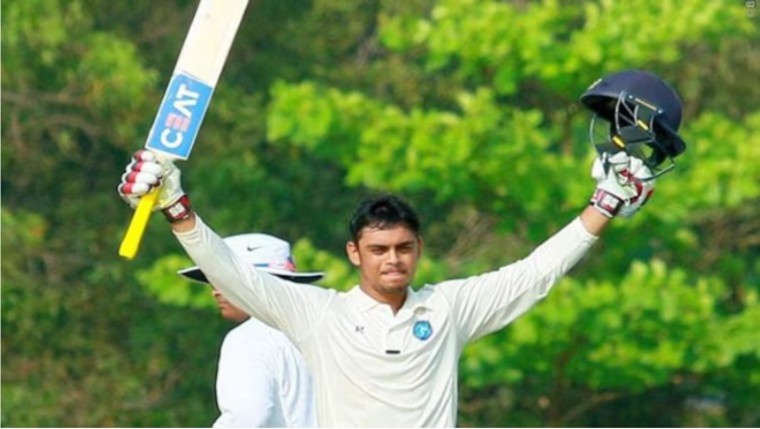
In 2016, he captained India at the U19 World Cup under Rahul Dravid, guiding the side to the final before finishing runners-up to West Indies.
That same year, he scored 273 against Delhi in the Ranji Trophy, a Jharkhand record, followed by a 136 against Saurashtra in the very next game.
The bat was always loud. The character is always louder.
The IPL Journey: Gujarat to Mumbai to SRH
Picked up by the Gujarat Lions in 2016, Kishan found his real home at Mumbai Indians from 2018 onward.
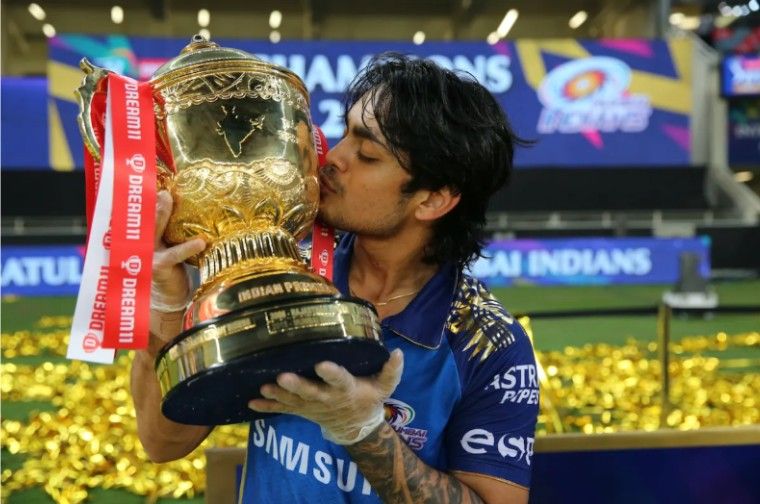
He was part of IPL-winning sides in 2019 and 2020, with IPL 2020 being his breakout season, 516 runs at a strike rate of 145.76, including a famous 99 in a Super Over thriller against RCB.
At SRH in 2025, arriving with a serious point to prove, he smashed a 45-ball century on debut against Rajasthan Royals, then followed it up with an unbeaten 94 off 48 balls against RCB as SRH posted 231.
Sunrisers retained him for the 2026 season without hesitation.
| Tournament | Mat | Runs | HS | Ave | SR | 100s | 50s |
|---|---|---|---|---|---|---|---|
| IPL | 119 | 2998 | 106* | 29.10 | 137.64 | 1 | 17 |
From Written Off to World Cup Opener
After two years on the outside, Kishan did not wait for an invitation; he demanded one.
He piled up 517 runs in the Syed Mushtaq Ali Trophy at a strike rate of 197.33, finishing as the tournament’s top run-scorer, before smashing 101 off 49 balls in the final to hand Jharkhand their maiden SMAT title.
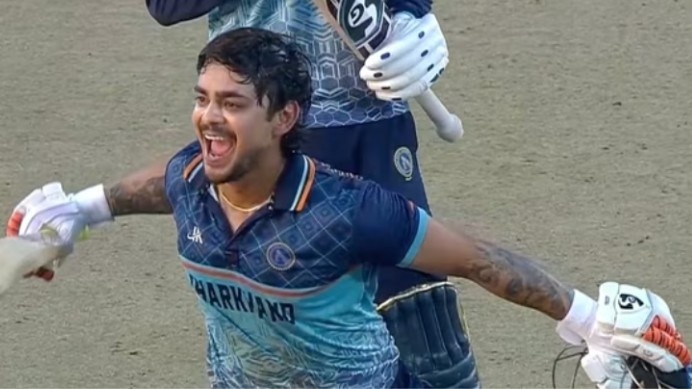
Days later, the BCCI named him in the T20 World Cup 2026 squad not as a backup, but as a frontline option.
At the tournament, he became the first Indian wicketkeeper to score a Fifty in T20 World Cup history, smashing 61 off 24 balls against Namibia.
Then came the defining moment against Pakistan in Colombo: Abhishek Sharma was dismissed for a duck in the first over, and Kishan walked in under pressure and produced a 40-ball 77 on a pitch where almost nobody else could score above a run a ball.
His 42 runs in the powerplay alone broke Shubman Gill’s record for the most individual powerplay runs in an India-Pakistan T20I. India won by 61 runs.
Kishan won Player of the Match, the first Indian wicketkeeper ever to do so in T20 World Cup history.
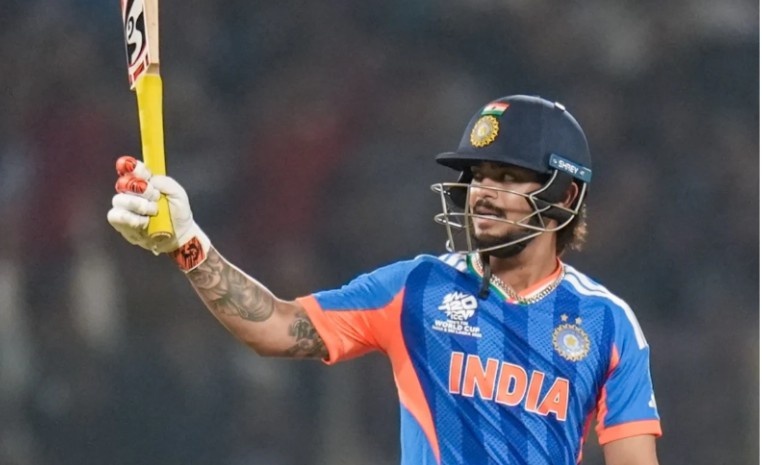
Pakistan coach Mike Hesson said it plainly: “Kishan’s fearless. Outside of that, no one really scored better than a run-a-ball. That innings certainly was a standout.”
His numbers since returning to the side tell the full story: 373 runs in seven matches, averaging 53.3 and striking at 215.6.
| Format | Mat | Runs | HS | Avg | SR | 100s | 50s |
|---|---|---|---|---|---|---|---|
| T20Is (2021–2026) | 40 | 1187 | 103 | 30.43 | 144.75 | 1 | 9 |
The Mentorship Behind the Comeback
Kishan did not rebuild alone. His Jharkhand head coach, Ratan Kumar, was a quiet but crucial presence throughout the domestic season. Kishan requested extra sessions almost every day, working with sidearmers, refining six-hitting drills, and ironing out technical gaps. Sessions were short, 30 to 40 minutes, but razor-sharp. That daily discipline is what turned hunger into output.
The player who was sidelined and forgotten is now the one India’s opponents are spending entire team meetings trying to plan for. And by the looks of it, they haven’t found an answer yet.