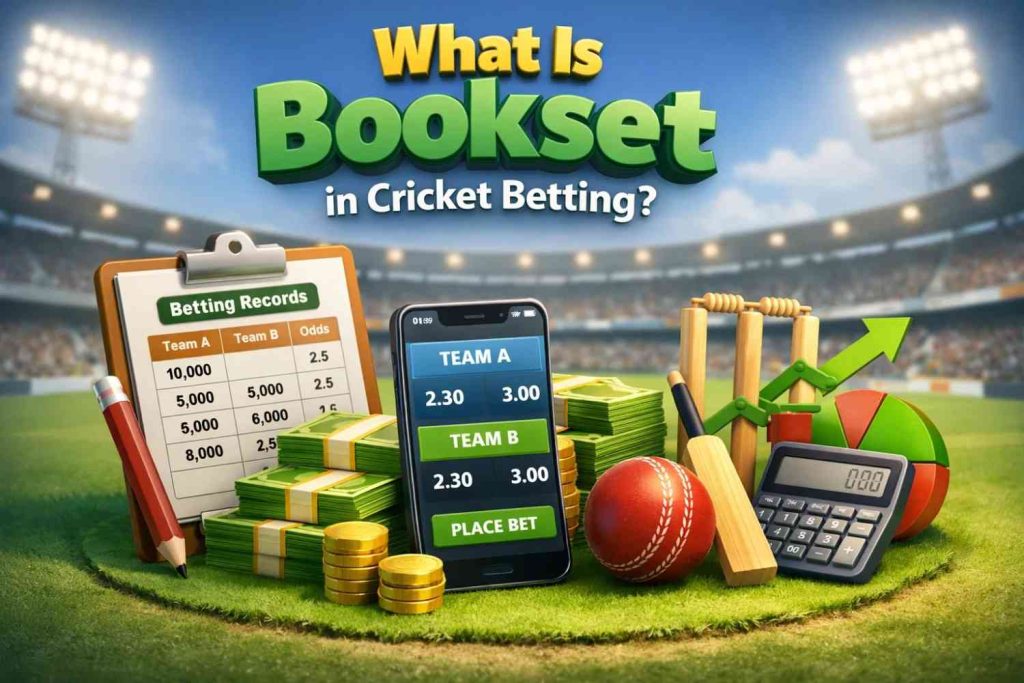
Bookset in cricket betting means placing bets on both teams at different times during a match so that you make a profit no matter who wins.
Most people who bet on cricket just guess. They pick a team, place a bet, and hope. Bookset is different. It is a method that uses odds movement to lock in profit before the match ends.
This guide covers the logic, the math, the steps, and the mistakes everything you need to understand bookset and start thinking like a trader instead of a punter.
What Is Bookset In Cricket Betting?
Bookset is when you place bets on both sides of a match at different odds at different points in time so that no matter who wins, you walk away with money. People call this locking in a Green Book.
A “Green Book” means every outcome in your bet record shows a profit. Green = profit on all results. That is the goal of bookset. You are not picking a winner. You are building a position where the result does not matter.
You are not trying to guess who wins. You are trying to catch the movement in odds. Odds do not stay the same during a match. They go up and down based on what happens on the field.
When odds move in your favor, you place a second bet on the other side. Now both results pay you. That is the whole idea.
The Logic of Bookset In Cricket Betting
Odds change during a match. A team that looks weak at the start can look strong after 6 overs.
When that happens, their odds drop. The other team’s odds go up. That gap between where you entered and where the odds are now is where the money sits.
Think about two types of people at a betting market.
The Punter backs a team and waits. He wins big or loses everything. The result controls him. He has no way out once the bet is placed.

The Bookset Strategist does not care about the result. He backs a team early at higher odds, waits for the odds to shift, then places a bet on the other side at the new odds. He locks in profit either way. The match result becomes irrelevant to him.
One hopes. The other trades.
How Bookset Differs From Standard Betting?
| Feature | Standard Punter | Bookset Strategist |
|---|---|---|
| Goal | Predict the winner | Catch odds movement |
| Risk | 100% of stake | Near zero once book is set |
| Outcome | Win big or lose all | Profit on both results |
| Timing | One bet, one moment | Two bets, two moments |
| Mindset | Emotional | Mechanical |
The difference is not about cricket knowledge. It is about how you think about risk and timing. Bookset is not a bet. It is a position you open and then close at the right time.
Step-by-Step: How to Execute a Bookset in Cricket Betting
There are three phases. Entry, wait, and exit. Miss any one of them and the book does not set.
Phase 1: Finding the Entry Point
You need to pick a team whose odds will drop during the match. Odds drop when a team starts to perform well.
In a T20, this can happen after a big over, a quick wicket, or a strong powerplay finish. In an ODI, it can happen after a good first 15 overs or a top-order collapse by the other side.
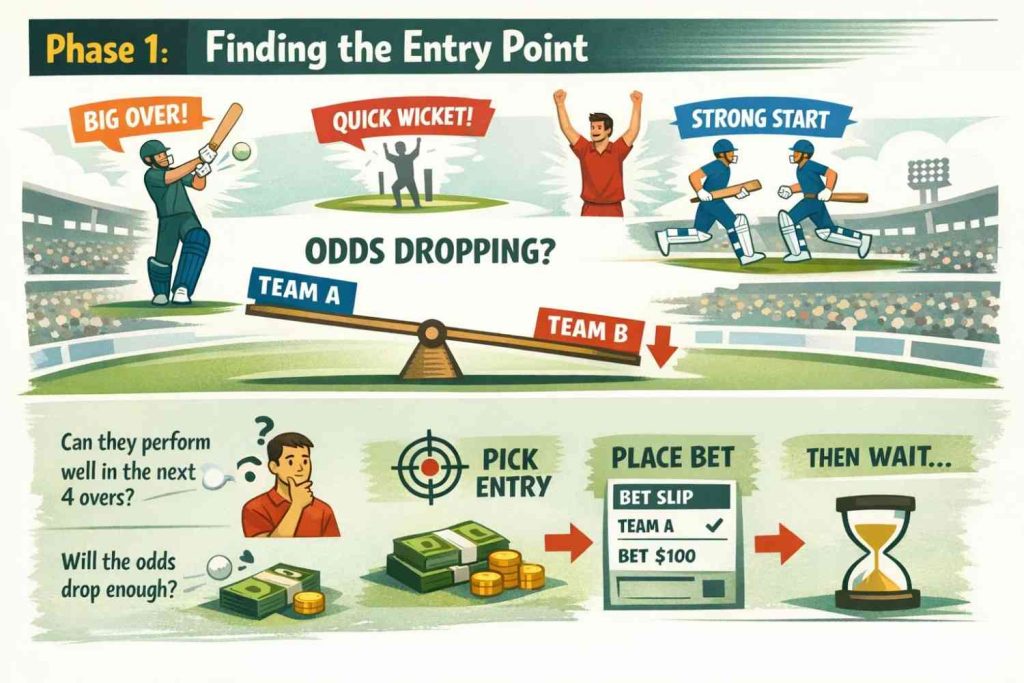
Look for matches where one team leads but has not dominated yet. That middle ground is where odds move the most. If one team is already a clear favorite from ball one, there is not much room for movement and not much to trade.
Ask yourself before placing the first bet: if this team performs well in the next 4 overs, will their odds drop enough for me to cover the other side and still profit? If yes, place the bet. If not, wait for a better match.
Pick your entry. Place your first bet. Then wait.
Phase 2: The Math Behind Bookset in Cricket Betting
Here is the formula:
Profit = (Stake×Odds)−Total Liability
You want this number to stay positive for both outcomes. That is when your book is set.
Example: India vs Pakistan A Green Book
| Scenario | First Bet (Back India @ 2.0) | Second Bet (Back Pakistan @ 3.0) | Net Profit |
|---|---|---|---|
| India Wins | +$100 | -$33 | +$67 |
| Pakistan Wins | -$100 | +$167 | +$67 |
Here is how to read this. You placed $100 on India at odds of 2.0 early in the match. If India wins at this point, you get $200 back $100 profit.
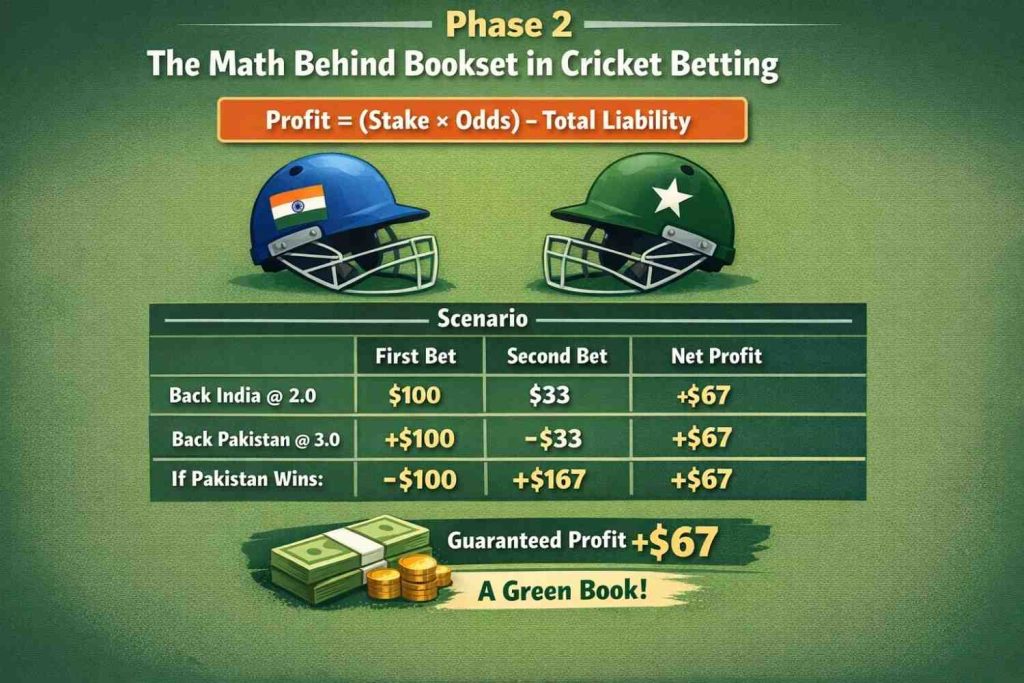
After India batted well in the powerplay, Pakistan’s odds drifted out to 3.0. Now you place $33 on Pakistan. If Pakistan wins, you get $100 back from that bet.
Add it all up and both results give you $67 profit. The book is set. You can watch the rest of the match without stress.
The key is the odds gap. The wider the gap between your first bet odds and the second bet odds, the more profit you lock in.
Phase 3: The Exit
Once the odds move enough, you place your second bet on the other side. This is your exit. The size of this second bet comes from a simple calculation you need to figure out how much to place so that both outcomes give you the same return.
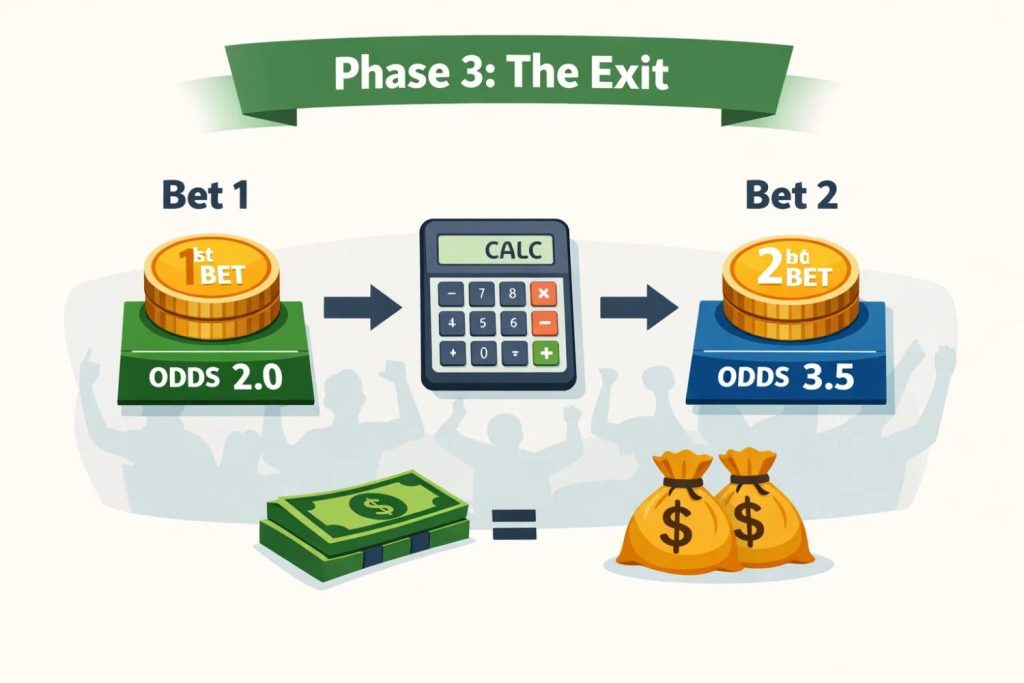
Once both bets sit in your account, your work is done. The result handles itself. If you find it hard to calculate manually, use a bookset calculator.
You put in your first stake, the first odds, and the current odds on the other side. It tells you exactly how much to place as the second bet.
Why Traders Use Bookset in Cricket Betting?
T20 and IPL matches work well for bookset. Odds move hard and fast in these formats. A dropped catch, a no-ball, a quick wicket any single moment can shift the market. That creates opportunity for anyone who watches the odds closely.
Traders treat bookset the way a stock trader treats a position. You get in at one price, the market moves, you close the position with a margin. You do not support a team. You do not care about the result. You follow the number.
There is Loss-Set. This is when your first bet goes wrong early in the match. The team you backed starts losing. Their odds go up. Instead of sitting and watching your money disappear, you place a second bet on the other side to cut your loss.
A loss-set does not always give you a profit, but it stops you from losing everything. You take a small, controlled loss instead of a large uncontrolled one.
Professional traders use loss-set the same way they use bookset. Both come from the same thinking manage the position, do not let the result manage you.
The gap between a gambler and a trader is this: a trader knows when to take a small loss and move on.
Mistakes to Avoid in Bookset in Cricket Betting
Most people understand the idea but still lose money. The concept is simple. The execution is where things break down. Here is where it goes wrong most often:
- Greed. You wait for odds to drop more. They do not. The window closes and you are stuck with one side of the bet. Take the profit when it is there.
- Low activity markets. You try to bookset on a match with very few bettors. The second bet does not get matched. Pick high-volume matches — IPL, World Cup, big series.
- Emotional decisions. You backed India and India is winning. You do not want to place the second bet on Pakistan because you want to win more. That is a punter move. Set the book. Take the green.
- Wrong bet sizing. You calculate the second bet wrong and your book does not balance. Use a calculator. Check the numbers before you place.
More Related Topics:
Conclusion: Bookset Means Betting On Both Teams At Different Times To Profit No Matter Who Wins
Bookset in cricket betting is placing bets on both sides of a match at different odds, at different times, to secure a profit no matter who wins. You are not fighting the result.
You are using the market’s own movement to your side. That shift in thinking is what puts a trader apart from a punter. One hopes. The other manages. This guide gave you the logic, the math, and the steps.
Now practice. Start with small stakes. Get the sizing right. Once you set your first green book, the whole method will make sense.
FAQs
A bookmaker sets odds for a match and takes bets from the public. They make money by adding a margin into every price they offer, so the house always has an edge.
Online betting through foreign platforms sits in a grey area in India. Laws vary by state. Check your local rules before placing any bets.
Booking a bet means confirming and placing it with a bookmaker. Once you book it, the odds lock in at that price for you.
A book is the full set of odds a bookmaker puts out for all outcomes in a match. A balanced book means they profit from any result.
AI can study patterns and give probabilities. It cannot predict a match with certainty. Upsets and random events make cricket hard to call.
Yes. Bookmakers add a margin into every set of odds. The total probability of all outcomes always goes past 100%, which locks in their profit.
A set of 7 selections is a “Super Heinz.” It holds 120 bets across doubles, trebles, and accumulators from those 7 picks.
Look for a platform with a license, tight odds, fast withdrawals, active cricket markets, and support you can reach when you need it.